myHeader

Showing posts with label creativity. Show all posts

Monday, February 20, 2012

Magic of the Kabala #2

Wow, the previous post on kabala magic got almost ten times more hits than an average post. Thanks guys!

As previously stated, this series is part of my greater effort to push Hebrew mythology and folklore into gaming, challenging Greeks, Vikings, Celts and whatnot in the process. If you have an image of a hassidic rabbi struggling with a viking guy at the moment... you're awesome!


Three Blessed Charms
While not part of the seven virtues, these charms are also useful and powerful and are worthy of mentioning. They follow the same rules as virtues, but don’t require such strict purity to attempt and have lesser consequences of failure (usually simply a -2 luck penalty to all rolls for 1d6+1 days or a minor misfortune of the DM’s choice.)
I am what I am
Protect and save
Amen

The Charm of Augury (see below)
Take a new knife with a black hilt and make a circle on the ground of such a size so that you will be able to seat inside it with a boy or a girl who are younger than nine years and older than eight years, and anoint the child with oil mixed with soot scraped from a pan, and warn him not to look outside the blessed circle, and after that whisper in his right ear "Catcriel who Answers, may you show yourself to this boy and answer truly to what I ask” three times whisper this and then the child will see a strange man riding a white mule and say to the stranger three times “welcome in the name of God," and after that say "right before my eyes, may you get down from this mule," and after that ask your question. And after you found out what you wanted to know, tell the stranger "leave in peace" and if the boy didn’t see anything of that, he will repeat all the above mentioned three times, but if the stranger lied, the child will say "in the name of Sansiel, may you tell me the truth," and remember naught of this and that.
And do this only once for every cycle of the moon* lest you invoke the wrath of the Almighty’s great host of righteous angels.

* a lunar month (29 or 30 days).

This powerful charm summons an angel to answer truthfully and to the best of his knowledge to a single question asked by the kabalist. Note that not all angels are friendly and certainly none of them are omniscient, so the answer given is likely to be untrue or partial, depending on the angel. In any case, as long as the kabalist and the child remain within the circle, both are safe from any physical or magical attacks attempted by the summoned angel.

Roll Outcome
1          The angel is offended and attempts to harm the kabalist
2-10     The angel gives an incorrect answer
11-16   The angel gives a partial answer
17-19   The angel answer the question
20         The angel answers the question and gives a useful advice

"Please, do pass..."

The Charm of Protection (DC 13)
To bring in the thief, take a newly-bought axe and write on it this holy name, and hang it above your door and the thief will come and surely be destroyed.

As soon as someone with ill-intentions enters the kabalist’s home, the axe immediately comes to life, attacking the intruder with a +14 attack bonus for 2d8+14 points of damage for three rounds before becoming an inanimate object again. Only one door per home can be trapped; trying to trap more doors simply cancels the previous charms.
This charm can be used in conjunction with the Virtue of Success.

The Charm of Legacy (DC 14)
For the baby to be wise, let the woman’s son or husband write on her breasts; Asa on the right breast and Tma on the left breast, and the baby will suck wisdom, and grow in wisdom, and walk only the path of righteousness, and fear no evil.

This charm is used by kabalists who want to ensure they have proper heirs to inherit their places and lead their communities in justice in wisdom. A baby who enjoyed this charm will gain a +4 inherent bonus to all mental abilities and his alignment will be Lawful Good regardless of the circumstances of his childhood. Substituting "Asa and Tma" with "Koh and Zri" will instead enhance the child’s physical abilities, but this is rarely used since Kabalists don’t particularly value physical prowess.

"Asa and Tma," sadly on paper...

Using all four names will grant a +8 bonus to all abilities, but will also guarantee the child will grow to be Chaotic Evil and betray his family and faith when he reaches maturity. Such monstrous children often grow to be mighty but depraved warlords or insane, scheming sorcerers of unspeakable potency.

I hope you've enjoyed this post. See you soon with more awesome rituals, creatures and even an antediluvian mini-campaign...

Saturday, February 18, 2012

Magic of the Kabala #1

A few years ago I was making my bread translating medieval tomes of Jewish mysticism into English. Many of the books I translated felt like excellent fantasy material. Below are some of these translations. Stuff written in italics is direct translation, everything else is my... update.

Translate?! I can barely read it!

The Awesome Power of the Explicit Name
Throughout their long history, the Jewish people had often been confronted with various threats, ranging from murderous pogroms and persecutions to supernatural assaults by evil spirits and antediluvian demons. Always the minority, and far from warlike, the Jews have developed a system of charms based on exploiting the immense power hidden in the explicit name of God (YHVH), also known as “The Great and Terrible Name.”
The charms presented below are mostly taken from the works of Rabbi Moshe ben Mordecai Zacuto of Venice (1625-1697), a poet and philosopher who also dabbled in kabalistic mysticism in his old age.
Because kabala is a tricky art at best, every charm has a chance to fail even if performed properly and with the best of intentions; whenever attempting to use a kabala charm, make a Wisdom knowledge check against the chram’s DC. Failure indicates the charm fizzled harmlessly, while a critical fumble bestows a curse (as if cast by a 20th level cleric) on the kabalist or inflicts him with some other kind of misfortune (chosen by the DM). In most cases, the kabalist will not know whether the charms worked or fizzled until it is too late. Where applicable, all charms have a save DC of 15 plus the kabalist’s Wisdom modifier.
The author does not recommend trying these charms in real life… just in case.

The Seven Virtues
The Seven Virtues are a collection of powerful charms given to Adam and Eve after they sinned before the LORD and were exiled from the Garden of Eden. The Holy, blessed be He, realizing that the fragile couple won’t survive in the harsh primordial environment into which they were cast, naked and unarmed, has created the Seven Virtues to insure the survival of humanity.
Upon finishing this wonderful tome, a massive book with sheets of crimson gold, letters of precious stones and covers of lustrous sapphire, He passed it to his most trusted servants, Raziel and Galizor, who delivered it to Adam and told him, “from these virtues you will know all that is destined to happen and will be able to accomplish whatever you want. But,” and the great angels’ features suddenly turned severe and terrible, “be wary, for it is consuming fire to abuse them; perform every virtue as ordained and you will succeed with great purity!”
The original tome given to the First Man was lost eons ago, but lesser versions of these charms are practiced by students of the mystic art of kabala to this very day. However, even the greatest scholars rarely choose to attempt these for fear of the consuming flame of God. Even these lesser virtues are extremely powerful and must be treated with caution and purity. Any of the following is considered impure and will result in the automatic failure of the charm and inflict a curse or some other kind of divine retribution on the kabalist;

• Touching a dead humanoid
• Eating tame food
• Straying from Lawful alignment
• Practicing any form of arcane magic or psionics
• Worshipping any beings save God
• Breaking or failing to perform a commandment (there are 613 of them!)


A right proper charm. Now all we have to do is skin a deer...

1. The Virtue of Kings (DC 13)
If you wish to go before a king or a ruler and have him do as you desire and to give you everything you want, take a miter on which a baby was born, and write on it these ten names and put it in your sash, and go with it before the king, the lord, or the government and he will undoubtedly give you your desire.

The Virtue of Kings grants a 2d4 temporary enhancement bonus to Charisma, adding the usual benefits to Charisma-based skill checks and other uses of the Charisma modifier. This bonus applies only to NPCs who are wealthier or more experienced than the kabalist and only if the request is just and sincere or works for the common good. So while asking for a bag of gold to help the community would work, suggesting the baron executed the kabalist’s rival would not (and probably cost the villain his own life).

2. The Virtue of Flying (DC 11)
For the Jumping of the Path, that is, to walk the path of a year in a single day or to cover the passage of a month in one hour, write these ten names on deerskin parchment and take a cane of four cubits, as the measure of a man, and cut the cane and insert the scroll inside it, and, during prayer, put on your face a handkerchief and ride on the cane and say this: “by the ten names which are written on the scroll which is inside this cane on which I ride, lead me from this place to place so-and-so,” and you will be there.
And be careful not to remove the handkerchief from your face before you reached your destination for then you will surely fall. And after you arrived to wherever you wanted to go, fest in reverence for three days and wash and purify your body and praise the LORD, for he is great and merciful.

The Virtue of Flying enables the kabalist to fly at the speed 50 miles per hour for as long as a day (12 hours) at a time, after which he must rest and purify himself before attempting the virtue again. During flight, the kabalist is extremely vulnerable because he must keep his face covered with a handkerchief, his arm holding the cane and his tongue repeating the prayer. If he fails to do so, the cane will lose its divine powers and the kabalist will plunge to his death.

3. The Virtue of Success (DC 5)
Wash and purify, and write these holy names on the newborn baby’s miter and on a forged silver flier and bury the miter and flier under the earth when the sun doesn’t rule, and in the morning remove them and hang them on the entrance to your shop or home and you will succeed in all of your endeavors.

This useful virtue grants the kabalist a +2 luck bonus to all non-combat rolls made inside his shop or home, as long as the kabalist deals fairly with his customers and treats his family kindly. Greedy kabalists who try to bless both their home and shop, suffer a
-4 luck penalty to all rolls as long as both fliers are in their places.

There is a lot of fun stuff you can do with the Explicit Name

4. The Virtue of Invisibility (DC 13**)
Take a twig, make a small cut in it, and write on a parchment made of a fallen deer’s carcass these excellent names and put the parchment inside the twig, and place it against your heart and walk in front of any man and he won’t be able to see you. But be warned; it is not proper to write it save during the month of Tamuz*.
* mid-June to mid-July.
** Wisdom check must be re-rolled for every minute of invisibility

This useful virtue has enabled many Rabbis to escape their persecutors without committing the sin of bloodshed. This works just like invisibility but is cancelled if used for theft, peeping, assassination or any other immoral purposes. In any case, the kabalist is able to see himself and can judge whether he is visible or not only by others’ reactions.
Also, the old manuscripts say that one should not stay invisible for more than ten minutes per day else he would disappear from the world completely. So far, no one has dared to test the truth of this dire warning.

5. The Virtue of Safety (DC 15)
To pacify the sea’s rage, take a new cauldron and write on it: “I, so-and-so, implore with the ten names of the fifth virtue that the lord of the sea, Zerukhael and the lords of the four winds pacify the sea from its rage and tumult and safeguard this ship from all evil until it comes to shore and let it be unharmed.” And shatter the cauldron and throw the shards to the four winds of the sea and reach your destination safely.

This powerful virtue is usually used by travelers who must travel to faraway lands. If properly performed, it guarantees good weather throughout the passage and automatically cancels any harmful encounter such as pirate raids or monster attacks.
The Virtue of Safety doesn’t work if there are more evil than good NPCs on the ship, instead turning the voyage into a nightmare of violent storms and murderous assaults until the good-to-evil balance is restored.

Ashtafa!

6. The Virtue of Commanding (DC 15)
Take a staff of the loz or ashira tree, and write on it these fabulous names. And if, while walking down the road, you see people who are mean to you or seek to do you harm, take the staff and strike the earth with it three time, and say each time “go your way” and they will go their way, and if you wish to hold them, say “stand” and they will stop, and write these names in great purity and use them not for evil lest you be swallowed by the earth.

This virtue is designed to protect the lone traveler from brigands and thugs. It affects anyone able to see and hear the kabalist and whose attitude is hostile. The first command causes the target/s (7 humanoids maximum) to walk away in a random direction for 2d4 minutes, while the second simply causes them to stand confused in their places, unable to decide what to do or where to go. Both commands can be avoided with a successful Will save (DC 20).
Any violence towards the target immediately ends the virtue’s effect and cracks the staff, rendering it useless.

7. The Virtue of Love (DC 17)
If you wish to be loved by all people and have them follow you because of the power of their love, take the born baby’s miter or a deer parchment that was worked by a pure man, and write on it these admirable words in purity and holiness. And after you have finished that, roll the parchment into a scroll and touch with it every man or woman and immediately they will follow you.

This virtue is the most morally ambiguous and as such is the least used by honest Rabbis and the most abused by corrupt kabalists. It causes anyone who doesn’t hold a specific grudge against the kabalist to become helpful for 24 hours, after which his attitude returns to what it was before the virtue’s application. Those affected by the virtue are not aware of the fact that they are being manipulated and attribute their sudden helpfulness to genuine respect or attraction, depending on their gender.

Need more kabala rituals for your game? Find them here!

Monday, November 28, 2011

Tormentors, Victims and Witnesses

First of all there are new gangs, this time with awesome crunch to go with the wicked fluff. So yay!

Secondly, after a long, long break, the second installment of my Creativity at the Table series is live on Geekcentricity. The author this month is a kid with a dark and awesome imagination and an unusual degree of erudition for his age. Very recommended.

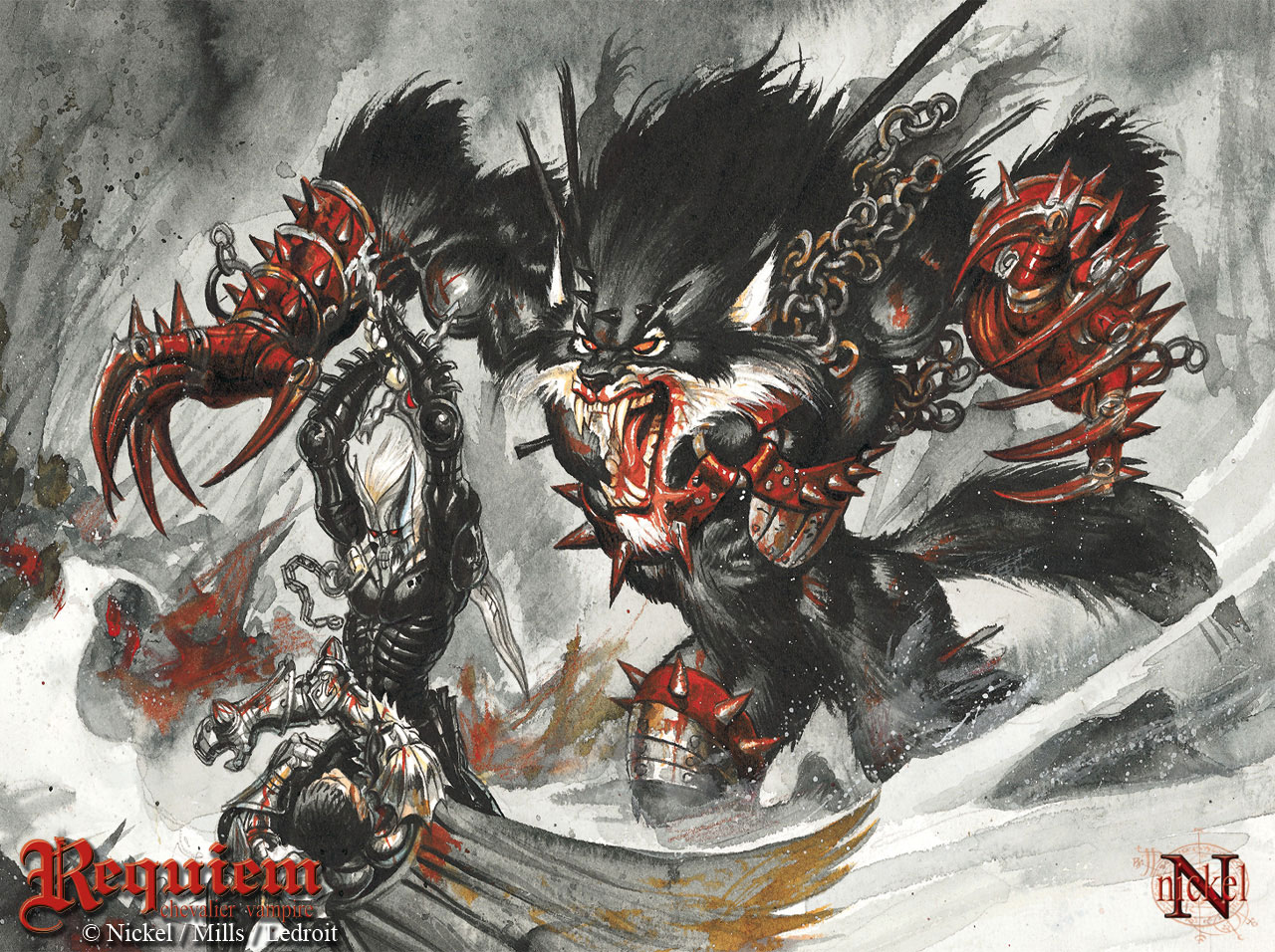
Thirdly, I’m currently running a camping remotely inspired by Requiem Vampire Knight. Yes, I realize this setting is not for children, but some concepts there are just too cool to walk by. I especially like the reversal of everything – people grow younger instead of older, archeologists bury the future instead of unearthing the past, decadence replaces progress, goodness is frowned upon and where there is sea in our world there is land there and vice versa. In short – opposite world.

Even more important are the races. The race of each character depends on how he lived and died. For example – hypocrites who do evil in the name of good return as ghouls, immoral people who never went above daily unkindness return as zombies, victims return as lamias, religious fanatics return as werewolves, those who consciously did evil return as vampires and so forth.

Twilight for boys

It’s a very cool comic; you really ought to read it.

Anyhow, my version is very much simplified and dematurized. There are three factions – Tormentors (undead), Victims (nature spirits) and Witnesses (wereinsects). The Tormentors live in castle Dracula and raid Victim camps in the forest. The Witnesses live in small fortified towns and condemn these heinous activities in the harshest possible terms, but never actually do anything.

Now the group in question is very unusual – all characters are LG and play Paladins, Clerics, Invokers or Avengers. Yesterday, after three sessions, they finally noticed that no one except them is breathing. The collective gasp was amazing!

I hoped for the group to form a basis for fourth faction, but presently, they are mostly concerned with finding a way to return home, the plight of the Victims being a very low priority for them. I’m half-tempted to inflict them with wereinsectism...

Also amazing - this picture.
Artist unknown... :(

Thursday, November 17, 2011

Flash Creativity

I played with some grown ups the other day. The son of one of the players didn't go to bed because he said it was very interesting to watch us play. It was a detective adventure and the boy soon started coming up with his own theories and suspects. At this point, his mother told him that he can't actually talk with NPCs, because he doesn't have a character.
After about a second of contemplation, the boy took her sheet, drew a amulet on her character illustration and said, "I'm a little spirit locked in the amulet. I can talk to you and through you."

You see this? This is an entire adventuring party.

I thought it was rather ingenious of him.

The group, by the way, rather liked the idea of tabletop RPGs. After a brief deliberation, we decided to go with Fading Suns. Speaking of Fading Suns, I cannot recommend the soundtrack of the Emperor of the Fading Suns enough. It's got a perfect mix between being exciting and being non-distracting. Perfect music for games!

Tuesday, November 15, 2011

Teaching Hate #2

When given the chance to shape a society or a group, kids almost always choose to create oppressive theocracies with rigid caste systems and perpetual conflicts on all borders. This is curious because the same kids, when responsible for themselves alone, are the very manifestation of gallant gentlemen. At the same time, their countries have inquisitions, death squads, unreasonable taxation and complete and utter disregard for sentient life. They are engaged in countless "holy wars" against non-believers, at the hands of whom they usually meet their just punishment.

When questioned about their external aggression and internal oppression, kids feign surprise. They offer these idiots the privilege of serving a PC and the yahoos refuse, does it not qualify them as evil? Also - we raid dungeons when we're a dozen or so, so why not rate kingdoms when we are several thousands?

I bet you didn't expect that, did you?

Last week I asked some higher level kids to create a hierarchy of classes. Two examples were especially curious, but all re-affirmed this tendency for semi-fascist theocracy. Below are excerpts from the states I liked the best, translated from the Hebrew by yours truly.

The Sons of Death
Clerics are the the most respected members of society. They are the babies who died at birth. A baby who was born dead is resurrected by a senior warlock. It grows up and on the age of 18 sticks a knife into its heart. For a year and a day, its body lies in a holy place. After a year and a day, the body is resurrected. The cleric is not allowed to tell what he’d experienced in this time. Warlocks are those who were born with such a strong magic spark that it only had to be harnessed. Wizards are those who developed the spark of magic until it became strong. During this time, it is believed that it meets with death and learns from it. Assassins are the most respected members of society after clerics and warlocks because even though they almost never use magic, they are still the servants of death. Next come the paladins, known as the knights of death. They are carefully chosen, it is forbidden for there to be clerics or warlocks in their families. In the acceptance ceremony they must kill a family member – preferably by torturing him. Only an absolute believer may become paladin.

I, for once, welcome our new snake overlords.


The Snake Holy State
Clerics are on top because they are chosen by Zehir and can tell everyone his will. After them comes the King who runs the kingdom according to the laws of Zehir. Then come the warrior who are mostly rangers and paladins. After them come wealthy and respected citizens - to become respected you must kill in the name of Zehir at least once. Then come the second class citizens who never killed - merchants, workers, healers and so forth. Then come the peasants and below them are only slaves, who are occasionally sacrificed to Zehir.

Thursday, September 15, 2011

When two men DMed thirty kids...

Last year, I was informed quite late in the evening that I was to run a game for about 30 kids the following morning. I objected, saying that D&D simply doesn’t work with such large groups, but was told that the alternative was being boiled alive, which at the time seemed worse than playing with a large group. Furthermore, I was to co-DM with a colleague who’s a real life Shadar-Kai, but also arguably the best DM in all of Asia – so there was hope. Hastily we developed a plan to save our throats and dignity.

We would break the class into three groups, each group representing the crew of a fantastic ship returning home after a long voyage. Before class, we arranged the tables in three blocks to represent three distinct vessels. For some time, the kids sailed toward the whiteboard, their home port nearing--

But woe is them! Suddenly they encounter Moby Dick AND the Kraken, deftly drawn by my partner on the whiteboard. Soon, blood and ink stain the water as a battle for survival insures.

"I'm so happy that you're back, let me hug you!"
"NOOOOO!"

Each kid got one of four below roles:

Helmsman
Ram (standard; at will) Navigation vs. AC, 40 damage and the target is stunned until the end of its next round.
Dodge (immediate interrupt, when an enemy melee attack hits the ship) enemy re-rolls attack. This ability can only be used once per round.

Gunner
Magic torpedo (standard; at will) Artillery vs. AC, Before firing declare how much damage you want to cause, for each 10 points over 100 you suffer a -1 attack penalty, for each 10 points under 100, you gain a +1 attack bonus.
Self destruct (minor action; daily) Automatic hit, 1000 damage in a 20 square radius. Ship and crew are destroyed.

Engineer
Repair (standard; at will) make an Engineering check, for each point you score over 20, the ship regains 5 hp.
Upgrade (standard; encounter) make an Engineering check, if you roll above 20 you get a minor bonus, if your roll above 25 you get a major bonus.

Healer
First Aid (standard; at will) make a Heal check, for each point you score over 20, each crew member regains 2 hp.
Prayer (standard; encounter) the ship either gains +2 to attack rolls or +2 to AC for the reminder of the encounter.

The monsters had a variety of attacks, which sadly I failed to record. However, these targeted both players and ships. I recollect the Kraken covering an entire vessel with ink and Moby Dick tail whipping several crew members to a watery hell. Yarrr!

All in all, we had to shout ourselves hoarse, but that was an enjoyable experience. Should you ever find yourself needing to DM to an epic-sized group, consider putting a ship under them.

Monday, September 5, 2011

Lawful. But is it Good?

I didn't plan to post today. I'm working on a major post right now, something that will hopefully expose some of the deeper flaws of our education system, but I hadn't quite found the words to plead my case yet. But sometimes, one just can't deny the urge to write. Please look at me with pity, graphomania is a serious condition.

Today, after I bit a dry marker in two to squeeze a little more ink from it, a boy commented, "the thing I like about you is that you don't care about manners, only about doing what you want," without the slightest hint of sarcasm. Was my action wrong? No, merely unorthodox.
Later that day a boy from a school all the way across town came to one of my classes. He said he didn't like his new instructor because, "she doesn't like noise and mess, like you do." Are noise and mess inherently wrong? No, merely unorthodox.

Some months ago, a girl had asked me if she may go to the bathroom. I asked her if this question was an inquiry as to whether she possessed the physical faculties needed to perform this basic anatomical function, or an examination of the socio-cultural norms concerning this activity. She looked at me queerly and went to the bathroom.

The point I wanted to make, and which I felt may have been lost on the polite young lady, is that I don't care if one is in the bathroom or not. There is no need to ask me. Just do it!

Now, don't get the wrong impression of me. Discipline in my classroom is not lax. If anything, I view myself as an old-school, possibly even an authoritarian, figure. I uphold the rules of the game and the rules of courtesy to the highest standards and if you don't play nice, you're not going to play at all.

However, I don't have needless rules. I don't care if a kid is sitting by the table or on the table. I don't care if he's wearing a hat in class. If the class is hot and the air conditioning is broken, I won't hesitate to go all McGuiver on the secured windows to get some air into the classroom. All these things would make a teacher faint. Why, just today a school principle phoned to scream at me that I left one of the classes in a mess. What kind of mess? The tables were all wrong, some of them were shifted almost a foot to the left.

I decided one of us must be insane. I just don't know who.

This can't possibly be fun! There aren't any perfectly aligned tables in this picture!


And yet, despite not measuring the table locations with an atomic ruler, if someone interferes in my game, I go Gygaxian on their ass. My tyranny on this subject had even earned me significant controversy in the past. The discussion of my DNDkids article on discipline had covered dozens of message boards and blogs and generated a discussion longer than longcat on the Wizards forums. But this harshness is justified in my eyes. It is needed. Needed for the game to be fun and for me not to throw myself out of the window I had just unscrewed.

And a guy standing on his head? Why, if it not his turn, he might as well climb the walls like Spiderman or fly around like Superman. He might even fight criminals like Batman - it's none of my business, now is it? He's not interfering with the game and he's not going to harm himself or anyone else, why should I rob him of his right of self-expression?

On the other hand, there is the education system. It screams at you for moving a table several inches. It screams at you for anything unorthodox. They would even scream at you for repeating the previous sentence.

This had led me to a revelation that struck me like an ACME anvil today as I drove back from my first day of work this year. Most laws are not meant to safeguard freedom or defend life or property in the schoolyard - they are meant to humiliate, dehumanize, and make slaves out of freefolk. They come from the same place as the endless and often comically absurd regulations of basic training - to show you you're nothing but a cog in the system. To make you nothing but a cog in the system. In a place which raises cannon fodder, it is right and proper. In a place which claims to create thinkers and virtuous citizens, it is laughable.

People say my classes looks like a jungle, maybe they do. I hope they do.

A jungle is such a nicer place than a prison.

Tuesday, August 23, 2011

Facebook Dreams #2

Last week I asked how to turn Facebook from a nightmare of spoilers and things no mortal should see into an awesome element of the game. Tonight I supply the answer. Read it carefully, for it is potent and likely to drive you insane.

Dream City
Lovecraft had the right idea. All dreamers go to the same realm when they're asleep, but some enter it like staggering idiots while others retain their faculties and can explore it just like any dungeon or mysterious continent. The PCs are hopefully dreamwalkers of the second sort.
The Facebook page is that city. In it adventurers from all over the land - from the hills of Modi'in to the forests of Shoham, from the sprawling city of Rishon to the rural charm of Be'er Tuviah - can meet and discuss their adventures. They can exchange information (page discussion), read news from around the world (wall posts), enjoy a hearty chat (FB chat) or a gallery of fine fantasy art (album) - but they can't fight. It's a dream, if you get too mad you just wake up, no harm done.
The last problem is trade. I mean, no one had ever gone to bed with a magic sword and woke up with it replaced by 5,000 gold coins. This is too outlandish even for a fantasy game.

Kids engaging in friendly barter, also known as "intimidate check."

Here the Dream Trading Company comes in with happy music and delightful smiles. These arcanes will gladly deliver goods and payments between interested parties in return for a small commission or a secret revealed. Should PCs threaten or harass them, they will just disappear in a puff of perfumed smoke, leaving the bully unable to dream-trade ever again.

So, what do you think of this solution. Do you see any possible problems with it? If you do, lemme know because the pilot begins in less than a month.

Friday, August 19, 2011

Facebook Dreams #1

Many of my students wanted to befriend me on Facebbok last year.

Now, my page is laden with profanities and death threats to random people, full of bad and, quite frankly, not that funny jokes and lists all my vulnerabilities. Worst, it contains spoilers to the kids' adventures. Worst still, it is written in a language they can't understand.

Instead, I created a new page just for the kids. It is written in a language that you can't understand... but google can. To my surprise, more often than not, the kids commented on pictures and posts in-character. Soon, the page became a buzzing market for rumors and information, something which I felt ambiguously about. On the one hand, it created an inter-city gaming community, enriched the games and encouraged creativity and self-expression (finally, a crowd that will listen and comment!). On the other hand it didn't make any sense inside the game world; how can a fighter hiding in a cellar in Menzoberranzan request directions from a vagabond sleeping on a bench in Urik, and why on earth does this vagabond have wikipedia...?

My boys created a map of their realm and were quick
to share it on the FB page with the cute caption, "join or die..."

By the end of the year, they wanted to trade items and even join forces to take on bigger monsters. Here, I just had to insist on the wall between the real world and fantasy world remaining intact. But this wall (pardon the pun) was already covered in graffiti on both sides and battered to the point of near collapse. Not to mention, I didn't care for this wall too much myself. But how to remove it, without removing the realism of the game with it?


This year, I think I found a solution!

Wednesday, August 17, 2011

Meet the Seven Tailed Sphere!

My first new article since my exile from Wizards is up. It's part of a new series that will feature creatures, classes, races, powers and eventually a whole setting created by my students during last year.

Some of them are pretty dark, but don't get alarmed. In fact, I don't think one should discourage children from using dark themes in their games because this is their way of mentally defusing them - better darkness on the paper than darkness in the soul.

And now, without further adieu - the infamous seven-tailed sphere!

Just one small request - the authors of these creatures may be reading your comments on Geekcentricity, so play nice :)